EV charging QR code payment: drivers pay only for what they use
Free for up to 20 chargers · no EzDIS commission per session · no credit card
Step-by-step setup guides for 38 charger models: Wallbox, ABB, Huawei, Schneider, Zaptec, Easee and more. See guides by brand
With EzDIS you charge whoever uses your OCPP 1.6J charger. The driver plugs in, scans the connector’s QR code, sees the price per kWh including taxes and pays from their phone with PayPal, MercadoPago or dLocal Go, with no app to download. The money goes straight to your account, with no middleman. They pay a maximum amount, charging starts and at the end what was not used is refunded through the same method. A single receipt is issued for what was used, filed with your country’s tax system if the account has e-invoicing.
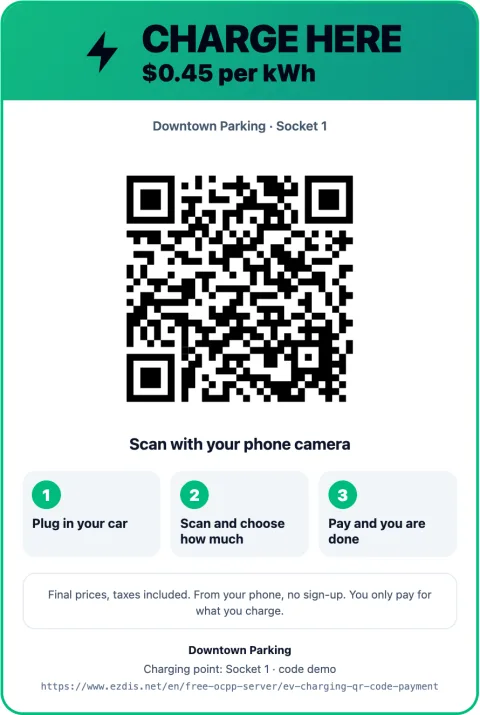
How charging works for the driver
- They plug the car into the connector.
- They scan that connector’s QR code with the phone camera and see the price per kWh including taxes.
- They choose a maximum amount and, if they want the receipt by email or in their name, enter their details.
- They pay that maximum with PayPal, MercadoPago or dLocal Go and charging starts. They follow the kWh and amount on their phone.
- When charging ends, or the maximum is reached, what was not used is refunded and they get the receipt for what was used.
How payment works
| Case | What happens to the money | Receipt |
|---|---|---|
| Paid and charged | Pays a maximum; at the end what was not used is refunded through the same method | One, for what was used |
| The charger does not start, rejects the command or delivers no kWh | Everything is refunded through the same method | None |
QR code for drop-ins, RFID for regulars
Both work on the same charger. A drop-in customer pays with the connector’s QR code. A regular (resident, monthly parker, member or employee) charges with their RFID card and, if you turn on the automatic monthly invoice, gets one invoice a month with last month’s sessions.
How to turn on QR payment on your charger
- 1 Add the charger under EV chargers, set the price per kWh and connect it with the OCPP URL the app gives you.
- 2 Connect your PayPal or MercadoPago account in EzDIS.
- 3 On the charger’s page, turn on QR payment and choose the tax and the receipt type. From then on the charger only charges with a QR payment or an assigned RFID card.
- 4 Print the sign with each connector’s QR code and the price, and put it where drivers can see it.
- 5 Run a test with a small amount: plug in, pay with the QR code and check that what was not used is refunded.
If the charger does not start, rejects the command or delivers no kWh, everything is refunded through the same method. The receipt is filed with your country’s tax system if the account has e-invoicing.
Your chargers can also be queried and controlled from ChatGPT or Claude. See how
Frequently asked questions
Does the driver need an app or an account?
No. They scan the QR code with the phone camera and pay on a web page; they do not sign up to EzDIS.
What if they pay and the charger does not start?
Everything is refunded through the same method. The same applies if no kWh were delivered.
Are drivers charged for what they did not use?
No. They pay a maximum and at the end the difference goes back through PayPal or MercadoPago, so they end up paying only for what was used.
What receipt does the driver get?
A single receipt at the end, for the kWh used, filed with your country’s tax system if the account has e-invoicing. They can leave their email and details to receive it.
Where does the money go?
To your PayPal or MercadoPago account, the one you connected in EzDIS, with the fees of your contract with that provider.
Does it work for the EU AFIR regulation?
AFIR requires publicly accessible charging points to accept ad hoc payment without a contract. For points below 50 kW it accepts a secure online payment, for example via a QR code. Public points of 50 kW or more need a card terminal: there the EzDIS QR code is not enough. Check with your adviser what applies to you.
Which chargers work?
Any OCPP 1.6J charger that lets you enter your own server URL, require a card and accept remote start and stop. If it has two connectors, each gets its own QR code. See the guides by model.
More OCPP guides
- OCPP charger not connecting
- SteVe alternative without your own server
- Free alternative to Monta, myWallbox or ChargeLab
- Enel X JuiceBox after the shutdown
- Apartment buildings and condos
- Hotels
- Parking lots
- Gyms and clubs
- Electric fleets
- Make money with your EV charger
- How to invoice EV charging without building OCPP
- Latin America EV charging with dLocal Go & MercadoPago
- For EV charger vendors, importers & installers
- Your charger with AI (ChatGPT or Claude)
- OCPP 2.0.1 server
- OCPI: your chargers in apps
- Chargers in Mexico (A/108)
- OCPP error codes
- Price per kWh calculator
Guides by charger model
- Besen BS20
- Wallbox Pulsar Plus
- Wallbox Commander 2
- Wallbox Pulsar Max
- Wallbox Pulsar Pro
- Wallbox Copper SB
- Huawei FusionCharge AC
- ABB Terra AC Wallbox
- WEG WEMOB Wall
- WEG WEMOB Parking
- Intelbras EVE City (EVE 0074C / 0110C)
- Schneider Electric EVlink
- Circutor eNext
- Orbis Viaris Uni
- Orbis Viaris Combi+
- Fronius Wattpilot
- Enel X JuiceBox Pro
- Autel MaxiCharger AC
- Teltonika TeltoCharge
- Teison OCPP
- ZJBENY BCP OCPP
- Khons OCPP EV Charger
- go-e Charger Gemini
- go-e Charger PRO
- Easee Home / Charge
- Alpitronic Hypercharger DC
- Maxus EV Wallbox OCPP
- Zaptec Go
- Zaptec Go 2
- Zaptec Pro
- Alfen Eve Single / Double Pro-line
- KEBA KeContact P30 x-series
- Mennekes Amtron Professional
- Smappee EV Wall
- myenergi zappi
- V2C Trydan
- Delta AC MAX
- Policharger OCPP
- EVBox Elvi
- Growatt THOR
- GoodWe HCA
- GoodWe HCA G3
- Generic OEM OCPP Wallbox
Checked on 2026-11-26 against the server code. Official OCPP reference (Open Charge Alliance).
Start billing charging sessions