How to set up Zaptec Go with EzDIS
1. Create the charger in EzDIS
- Sign in to EzDIS, open EV Chargers and tap Add charger.
- Enter a Name (for example “Bay 1”) and the Max power (kW), then save.
- Connect “Bay 1” opens with the data you will enter in the Zaptec Go:
- Server address (OCPP URL):
ws://devices.ezdis.net:9000/ev4k2p9x7q1m. - Secure address (wss://):
wss://charger.ezdis.net/ev4k2p9x7q1m. Use it if the charger supports a secure connection. - Charger identifier:
ev4k2p9x7q1m. On the charger it may be called ChargeBox ID, Charge Point ID or Identity. - Password, if the charger has that field. It is shown only once.
- Server address (OCPP URL):
If the charger has a separate field for the identifier, fill it in and still paste the full address: EzDIS recognizes the charger even if it adds its identifier or serial number to the end.
The data above is an example: use your charger's own. Each charger has its own identifier.
2. Configure the Zaptec Go
Zaptec is configured in the Zaptec Portal (or the Zaptec app), on the installation, with owner or service permission. Direct OCPP 1.6J needs recent firmware: Go 2.4.2.4 or later (EU; 2.5.1.0 in the UK), Go 2 3.2.1.0 or later and Pro from serial number ZPR080000 with 7.5.4.0 or later.
- In the Zaptec Portal, open the installation and go to Settings → Authentication.
- Under Authentication type, choose OCPP 1.6J (direct connection from the charger). OCPP 1.6J cloud goes through the Zaptec cloud and also works.
- In URL type:
- With a single charger in the installation: the full address,
wss://charger.ezdis.net/ev4k2p9x7q1m. - With several:
wss://charger.ezdis.net/{deviceId}. Zaptec replaces{deviceId}with each charger's serial number (for example ZCS000143).
- With a single charger in the installation: the full address,
- Keep Authorisation required on, so EzDIS validates the RFID cards, and tap Save.
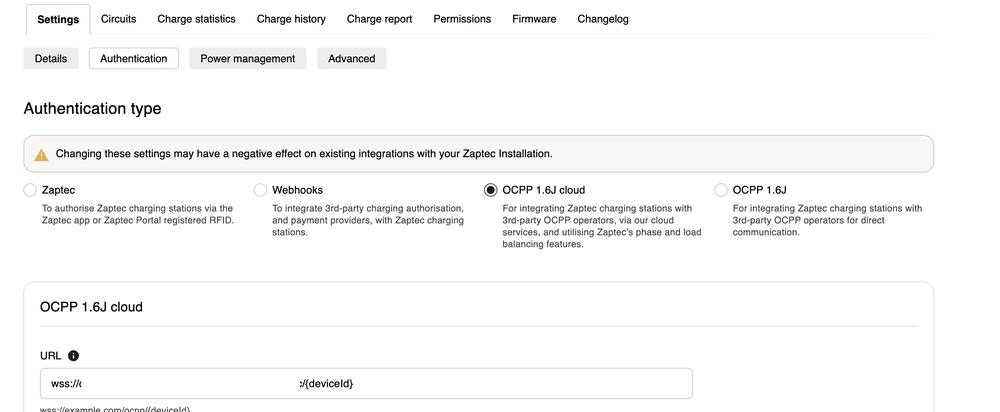
Source: Zaptec, “Configuring your installation to an OCPP server”
- Open each charger and, at the bottom of its settings tab, under OCPP Settings → Password, enter that charger's EzDIS password. The installation URL overrides the charger's, so there is no need to change it there.

Source: Zaptec, “Configuring your installation to an OCPP server”
3. Check the connection
With the full address, the charger shows as Available in EzDIS within a minute or two. If you used {deviceId}, each charger presents itself with its serial number: open each charger's page in EzDIS from the site's network and tap It is “…” when “A charger is trying to connect from your network as ZCS…” appears. For several chargers choose OCPP 1.6J (direct): with OCPP 1.6J cloud the connection comes from the Zaptec cloud, not from your network, and that notice does not appear.
If it does not connect
- Check that the charger has internet access and that the address is complete, with no spaces.
- If the charger page shows “A charger is trying to connect from your network as…”, tap It is “Bay 1”: your charger uses its serial number as identifier and connects on its next attempt.
- If it says the server rejected it, the password does not match or the charger is not using the secure address (wss://).
Once connected you can start and stop sessions from EzDIS, register RFID cards, charge per kWh and see each person's usage: it is all in the EV chargers manual.
Manuals and documentation
Documentation reviewed on 2026-11-24. Compatibility depends on the variant and firmware.