# How to set up ZJBENY BCP OCPP with EzDIS
Documentation reviewed on 2026-11-24. Compatibility depends on the variant and firmware.
## Before configuring the charger
The BENY/EVB OCPP guide uses Z-BOX for the OCPP variant. Set up the charger network first, then open server settings. Use the EzDIS URL and identifier; a Smart or Bluetooth-only variant does not confirm OCPP support.
## 1. Create the charger in EzDIS
1. Sign in to EzDIS, open **EV Chargers** and tap **Add charger**.
2. Enter a **Name** (for example “Bay 1”) and the **Max power (kW)**, then save.
3. **Connect “Bay 1”** opens with the data you will enter in the ZJBENY BCP OCPP:
- **Server address (OCPP URL)**: `ws://devices.ezdis.net:9000/ev4k2p9x7q1m`.
- **Secure address (wss://)**: `wss://charger.ezdis.net/ev4k2p9x7q1m`. Use it if the charger supports a secure connection.
- **Charger identifier**: `ev4k2p9x7q1m`. On the charger it may be called ChargeBox ID, Charge Point ID or Identity.
- **Password**, if the charger has that field. It is shown only once.
If the charger has a separate field for the identifier, fill it in and still paste the full address: EzDIS recognizes the charger even if it adds its identifier or serial number to the end.
The data above is an example: use your charger's own. Each charger has its own identifier.
## 2. Configure the ZJBENY BCP OCPP
BENY OCPP chargers are configured with the **Z-BOX** app. They ship in Bluetooth mode: you first add them over Bluetooth and then switch them to OCPP mode.
1. Install **Z-BOX** (Play Store or App Store), turn on the phone's Bluetooth and tap **Add Device**. Pick the charger from the list and enter its password (factory `123456`). Change it afterwards.
2. Sign in to your Z-BOX account (**Sign In**; if you have none, **Sign Up** with your email).
3. In the charger settings, tap **Switching Remote Control Mode**.
4. In **Server Configuration**, choose **Others** and enter the full address, `wss://charger.ezdis.net/ev4k2p9x7q1m` (or `ws://devices.ezdis.net:9000/ev4k2p9x7q1m`). Turn on **Enable HTTP Basic Authentication** and enter the EzDIS password. BENY's screenshot shows this screen with its own Z-BOX server selected; with **Others** it asks for your own server's details.
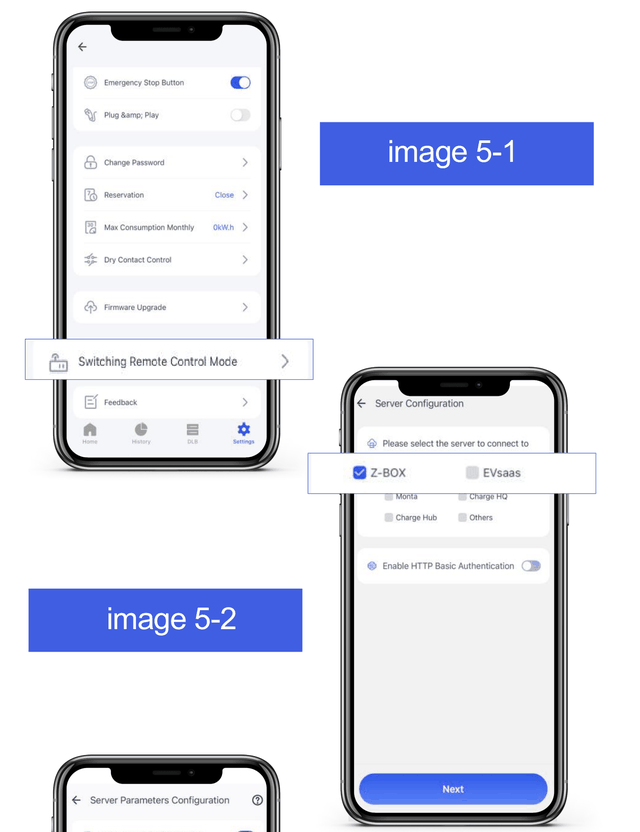
Source: BENY, “Z-BOX App Instruction Manual – OCPP Server”, p. 8
5. Tap **Next**. In **Server Parameters Configuration**, keep the values and continue. In **Networking mode configuration**, choose **Wi-Fi**, **4G** or **Ethernet**, enter your network and its key, and tap **Next** so the charger connects.
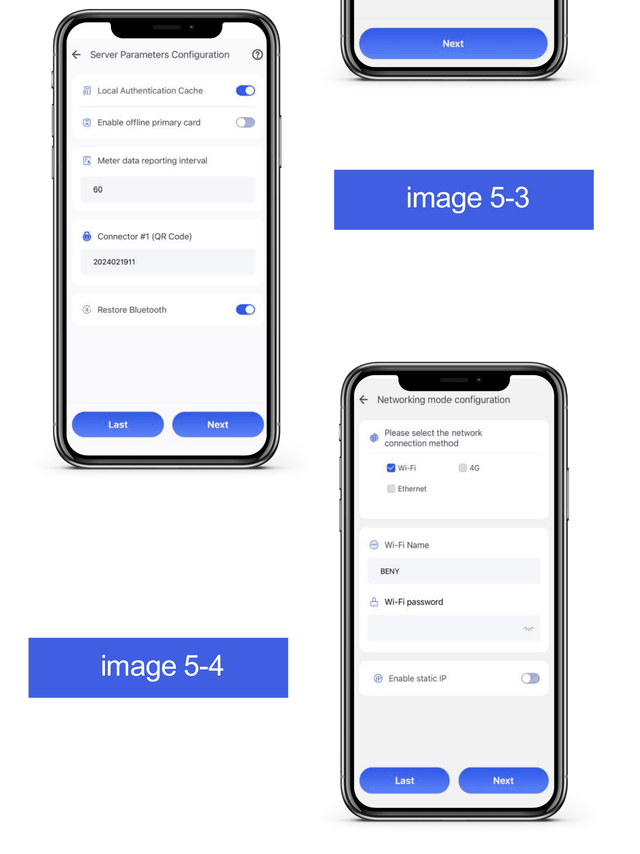
Source: BENY, “Z-BOX App Instruction Manual – OCPP Server”, p. 8
## 3. Check the connection
Within a minute or two the charger shows as **Available** in EzDIS. To use it over Bluetooth only again, the app has an option to switch from OCPP back to Bluetooth.
## If it does not connect
- Check that the charger has internet access and that the address is complete, with no spaces.
- If the charger page shows “A charger is trying to connect from your network as…”, tap **It is “Bay 1”**: your charger uses its serial number as identifier and connects on its next attempt.
- If it says the server rejected it, the password does not match or the charger is not using the secure address (wss://).
Once connected you can start and stop sessions from EzDIS, register RFID cards, charge per kWh and see each person's usage: it is all in the [EV chargers manual](https://www.ezdis.net/en/manual/1.0/guides/ev-chargers).
## Manuals and documentation
- [User and installation manual](https://www.evb.com/wp-content/uploads/2026/01/App-Instruction-Manual-ocppServer.pdf) — PDF
[Download the PDF tutorial](https://www.ezdis.net/en/free-ocpp-server/beny-bcp/tutorial.pdf)